

Οκτακομματική
Βουλή με πρώτο τον ΣΥΡΙΖΑ, με διαφορά 4 εκατοστιαίων μονάδων από τη Ν.Δ.,
δείχνει μέτρηση της βρετανικής εφημερίδας Guardian.
Στο πίνακα της
βρετανικής εφημερίδας εμφανίζεται και το Κίνημα του Γιώργου Παπανδρέου
να μπαίνει οριστικά στην Βουλή.
Το δημοσίευμα, επικαλείται αναλυτές
που παραδέχονται πως, πέρα από εκλογική μάχη, το αποτέλεσμα της 25ης Ιανουαρίου
θα είναι μια μορφή δημοψηφίσματος για την Ευρώπη.
Ο πίνακας
με τα αποτελέσματα που δημοσιεύει η εφημερίδα, είναι ο
εξής:

Greece Election 2015: the politics and economics in numbers
From the election polls to government
debt - here’s a look at the figures behind the Greek election
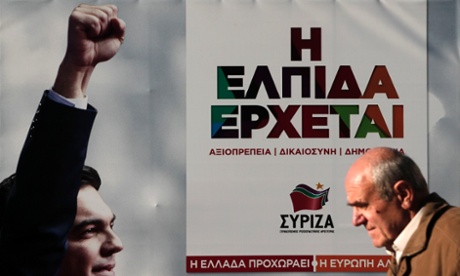
A man
walks past a banner with an image of opposition leader and head of radical
leftist Syriza party Alexis Tsipras at the party’s pre-election kiosk in
Athens. Photograph: ALKIS
KONSTANTINIDIS/REUTERS
Following the Greek
parliament’s failure to select a new president at the end of last year, early
elections were called for 25 January. Having topped last year’s European
parliament elections, the radical left and anti-austerity party Syriza is ahead
in the polls. Syriza wants to renegotiate the terms of Greece’s bailout deal.
Many analysts believe the election, which outgoing prime minister Antonis
Samaras of the centre-right party New Democracy (ND) has described as a
referendum on Europe, could drag the eurozone back into a crisis.
Based on these
polling figures there are several interesting factors to track.
While Syriza
is likely to emerge as the largest party, it is unclear if party leader, Alexis
Tsipras, will have the numbers needed to form a government.
SYRIZA's poll lead consistent but parliamentary majority elusive http://t.co/IIEUGC0zgA #Greece #politics pic.twitter.com/MeIUidVbb7
— MacroPolis (@MacroPolis_gr) January 12, 2015
If Tsipras does become PM, at 40 he would be the
country’s youngest ever PM - well below the average age (64 years old) of PMs
since 1974. He would also become the sixth
Greek prime minister since German chancellor Angela Merkel took office in
2005 - that’s more leadership changes than any other euro zone member
country.
Greece’s parliament is comprised of 300 seats, 250 seats are
assigned via proportional representation, and the other 50 awarded to the party
that wins a relative majority. There is a threshold of 3% required for entry
into parliament.
Currently both centre-left parties, PASOK and Kinima (a new
party launched this year by former PM George Papandreou) are polling perilously
close to the threshold. Despite never being home to Europe’s most stable of
governments, the PASOK figure is all the more extraordinary considering that in
elections since the 1980s, the centre-left party and centre-right ND have
consistently won a combined 80-85% of the vote.
This two-party dominance of
course changed following Greece’s economic collapse and subsequent
bailout.
In the two elections held in 2012, ND and PASOK won a combined 32%
and 42% of the vote. The two elections also set the stage for Syriza’s rise. The
party went from previous levels of single-digit support to 17% in May 2012, to
27% a few months later.
In 2012, the far-right Golden Dawn, which had
virtually no support in all previous elections since the party launched in the
1990s, won 7% of the vote. The party is now polling just below those
levels.
The communist KKE party is on 5.5%, in-line with its historic levels
of support. The pro-Europe party To Potami, founded by TV presenter Stavros
Theodorakis in 2014, is expected to win about 7% of the vote. The party elected
two MEPs to the European Parliament in last year’s EU elections. While the
right-wing anti-austerity party Independent Greeks (ANEL) are likely to see
their support halved and may struggle to win representation in the new
parliament.
But the election will be as much about political arithmetic as it
will be about economics.
Greece’s GDP comprises less than 2% of the
eurozone’s economy, but it is the fear of contagion and the precedent that an
exit from the currency would set that worries governments and investors. According
to most analysts though, a Grexit remains relatively unlikely, and
the risk of contagion to other countries is today lower than it was in
2012.
Nevertheless this hasn’t stopped the speculation and rumours. The
German government has
denied reports that it is relaxed about Greece leaving the euro. But one
group that definitely doesn’t want a Grexit are the Greek people. A
clear majority think the euro is “a good thing for Greece” despite years of
hardship following a painful austerity programme to keep Greece inside the
currency union.
Greek support for the euro - which
peaked during negotiations over the country’s second bailout in 2011-12 - has
been consistently higher since the onset of the debt crisis. During the years of
plenty, after Greece joined the euro, barely 50% of the population supported a
currency union.
When Greece joined the euro in 2001 - a late entrant admitted
under fudged
statistics - it was one of the two poorest members of the eurozone, along
with Portugal. Greek’s membership of a larger union of states gave European
lenders a false sense of security about its economy. Money flooded in, as banks
decided that lending to Greece was as safe as lending to Germany.
Successive Greek governments went on a spending spree the country
couldn’t afford, including the
2004 Olympics, which officially cost €6bn, although the final bill was
allegedly more than four times higher. The Greek minimum wage rose by more than
50% in the decade after Greece joined the euro, against a relatively more
stagnant EU average.
In 2001, Greek unemployment was close to 11%, the
highest in the eurozone. At the peak of the financial crisis a quarter of Greeks
were unemployed. The youth unemployment rate nearly hit 60%.
But many
of Greece’s deeper problems went unreformed.
Corruption, also among the worst
in the EU, went unchecked. Widespread tax evasion meant collection rates of
income and wealth taxes were well below the EU average. In 2009, self-employed
people hid €28bn (£21.7bn) income from tax authorities, according to a study
published by Chicago Booth business school that compared bank records to tax
receipts.
It was not only the middle classes. Around 2,000 wealthy Greeks
had €1.5bn squirreled away in Greek bank accounts, according to data uncovered
by the French authorities - aka the
Lagarde list.
But Greece eventually paid a terrible price for its
artificially-inflated boom. The country has endured six years of recession.
Unemployment has soared; almost half of all young people are unable to find
work. Around 3.9m people, more than one third of the population live below the
poverty line, according to official data from Eurostat. In a recent survey, 47%
said their family income was inadequate to meet their needs; while 55% said they
had borrowed from family or friends, sold or pawned assets, or taken out loans
to keep themselves afloat.
Meanwhile, TV licenses are still handed out for free (£), and according to
SIPRI data, Greece has the second highest military spending as a percentage
of GDP among NATO members - but after having enjoyed seven decades of tax-free
status enshrined in the constitution, taxation on the
country’s shipping magnates was introduced last year,
The most mobile
Greeks have emigrated. In 2012 the country suffered the fifth largest population
drop in Europe - only Ireland, Latvia, Estonia and Lithuania saw a bigger fall.
Last year net migration reached 52,000. For those who stay, public services are
buckling under cuts. Around 6.5% of the population have said they are unable to
get the medical attention they need. The Greek healthcare system is mostly free
at the point of use, so the numbers probably reflect deep
cuts in healthcare budgets that have led to chronic staff shortages, the
closure of some services, and hospitals without basic supplies, such as surgical
gloves.
Against this backdrop, it is little surprise that the favourite to
win Greece’s snap election, Alexis Tsipras, has pledged to “cancel
austerity”.
His promise that Greece will leave its current bailout programme
without further cuts puts him on a collision course with the European
Commission, the International Monetary Fund and European Central Bank that have
underwritten Greece’s €240bn bailout plan, in exchange for swingeing cuts and
economic reforms.
Germany’s finance minister, Wolfgang Schäuble, has
insisted “there is no alternative” to the current programme. Finland’s prime
minister, Alexander Stubb, said he would give “a resounding no” to any attempt
to write-off Greece’s debt.
Some eurozone politicians have hinted that
Greece could get more time to repay its debts. But even the current plan
envisages Greece will be weighed down by debt for the next decade: the IMF sees
Greek debt falling to 117% of GDP in 2022, down from 175% today.
If the polls are
accurate and Syriza does lead the first anti-austerity government since the
crisis, the stage is set for what may become the biggest confrontation yet over
the future of the eurozone - at least since the great Greek bailout of
2010.

Δεν υπάρχουν σχόλια:
Δημοσίευση σχολίου