

Sceenshot από Guardian
Ο διεθνής τύπος σε όλη την Ευρώπη αναφέθηκε στην τελευταία έκθεση της Διεθνούς Διαφάνειας,
θέλοντας να καταδείξει ότι διαφθορά στην Ελλάδα έχει αυξηθεί κατά τη διάρκεια
της κρίσης Η οικονομική κρίση συνδέεται άρρηκτα όμως με τη διαφθορά, όπως
έσπευσαν να σημειώσουν και στο εσωτερικό της χώρας..(;)
Μεταξύ των
«μετεξεταστέων» στο Δείκτη Αντίληψης της Διαφθοράς CPI2012 είναι πράγματι οι
χώρες της Ευρωζώνης που πλήττονται από την οικονομική κρίση, με τρανό παράδειγμα
την Ελλάδα, η οποία καταλαμβάνει την 94η θέση (με βαθμό 36) μαζί με
την Ινδία, τη Σενεγάλη και το Μπενίν. Σύμφωνα όμως με τον Πρόεδρο της Διεθνούς
Διαφάνειας-Ελλάδος (ΔΔ-Ε) κ. Κώστας Μπακούρης κατά τη συνέντευξη τύπου για την παρουσίαση του
CPI : «Τονίζουμε ότι ο δείκτης απεικονίζει αντιλήψεις και όχι
πραγματικά γεγονότα διαφθοράς στο δημόσιο. Η εικόνα και η αντίληψη για
το τι συμβαίνει σε μια χώρα χρειάζεται χρόνο για να ανασκευαστεί. Και δυστυχώς ο
χρόνος κυλάει εις βάρος μας. Αν έχουμε κατά νου αυτό, το αποτέλεσμα δεν πρέπει
να μας εκπλήττει. Η χώρα μας λόγω της οικονομικής κρίσης βρίσκεται στο διεθνές
προσκήνιο τα τελευταία χρόνια. Τα προβλήματα της διαφθοράς κατακλύζουν
πρωτοσέλιδα στον διεθνή τύπο.» Αμφιβάλλουμε αν η διαφθορά με βάση αυτό το
δείκτη, έχει αυξηθεί στην Ελλάδα εξαιτίας της οικονομικής κρίσης και των
μνημονίων... Το πιο πιθανό οι αντιλήψεις να άλλαξαν για το επίπεδο διαφθοράς της
χώρας, καθώς η Ελλάδα είναι στο επίκεντρο του διεθνούς ενδιαφέροντος. Φυσικά
υπάρχει διαφθορά σε τεράστιο βαθμό που θα έπρεπε να καταπολεμηθεί και πρωτοβουλίες όπως αυτές του Στουρνάρα για ποινές χωρίς
ανασταλτικό χαρακτήρα για περιπτώσεις φοροδιαφυγής είναι προς τη σωστή
κατεύθυνση...
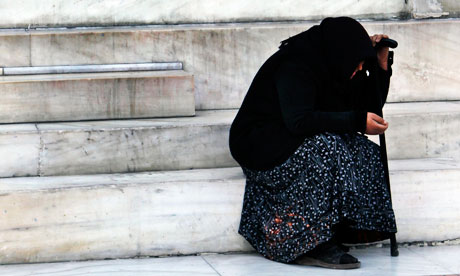
Greece slips to 94th in corruption index as austerity makes it EU's weakest link
An old woman begging in Greece,
where one in three now live below the poverty line. Photograph: Yannis
Behrakis/Reuters
On top of the litany of woes that have befallen Greece, comes the news that
the eurozone's weakest link is also its most corrupt. From holding 80th place in
the 176 countries on Transparency
International's corruption perceptions index in 2011, Greece's global
ranking, this year, fell to 94, the global watchdog announced on Wednesday. In
terms of perceived levels of public corruption, Greece was on a par with Moldova
and Mongolia. In the 27-strong EU, there was no other state that fared
worse.
For economic experts who were surveyed for the report, the finding
will be further proof that Greece is not just an economic basket case that is
only barely keeping bankruptcy at bay but entrenched in a crisis of values that,
like its debt drama, refuses to go away.
For Costas Bakouris, who spends his
time exclusively monitoring corrupt practices as the head of Transparency
International's Greek chapter, the survey underscores the desperate need for the
nation at the heart of Europe's financial mess
to organise a fresh political way of operating.
"We need to create a
political system where politicians care more about the fate of the country than
themselves," he told the Guardian.
"In short, we need to make politicians
accountable," he said, emphasising that wanting ethical standards had played a
pre-eminent role in bringing the country to "this critical
place".
Ironically, most Greeks would agree. Corruption, as many now
understand, was the thorn in the side of a society that held back economic
enterprise and competition. It was their nation's overarching affliction.
But
the drop will also come as little surprise. And, for many, it will have less to
do with the lack of role models - and punishment, or not, meted out to corrupt
politicians - as it will do to the sheer need to survive.
In a country not
only mired in a fifth straight year of recession but enduring a third year of
unprecedented austerity, where one in three now lives below the poverty line and
a quarter of the population is unemployed, corruption is a means to an
end.
It is, say analysts, the flipside of austerity in an economy in
freefall. "To survive in such a hostile situation, you have to bend the rules,"
said political commentator Giorgios Kyrtsos. "There is no other way when things
are so hard - you are forced to resort to corruption to deal with the state
mechanism."
Economics professor Theodore Pelagides says rampant tax evasion
is a case in point. With VAT at 23%, thanks to policies mandated by Greece's
creditors at the EU and International Monetary Fund, withholding of official
receipts has assumed proportions that even by the standards of pre-crisis Greece
have become chronic.
"People have been pushed to their limits. They have
calculated in a very rational way that avoidance of such receipts is a necessity
at a time when they have been hit by so many wage cuts and unexpected taxes,"
Pelagides said. "We should not be at all surprised by the report's
findings."
Will it get worse? Very likely, yes. This week another global
survey conducted by the consultancy group Mercer found that, in Athens, citizens
endured the worst quality of life of any major European city. It was also the
78th most expensive of the 214 cities that were surveyed.
With no prospect of
development or growth to get them out of the economic depression, and more
biting belt-tightening measures on the way, Greeks are the first to say they
fear "a jungle-like" mentality is bound to emerge.
Desperation is on the rise
with the state power company DHE reporting it is cutting off electricity
supplies in an estimated 30,000 homes every day as bills, which now include a
hefty property tax, go unpaid.
"Our country is being destroyed a little more
every day," said Tassos Vassiliou, who runs an electric supplies store in a
downtown office.
"This shop has been in my family for more than 100 years and
at Christmas we will close. We will open up in my family home next door, but
don't ask for a receipt because we won't be giving them
out."
Δεν υπάρχουν σχόλια:
Δημοσίευση σχολίου